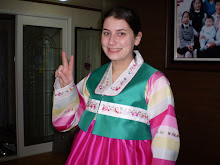
All I have today is a link to a New York Times opinion piece about the adoption system in South Korea. It's written by a woman who was born in Korea but adopted by a family in the United States.
http://relativechoices.blogs.nytimes.com/2007/11/27/south-korea-and-its-children/
I'd recommend going on to read the comments sections, as it has some interesting thoughts about not only adoption in general but South Korea's attitude towards orphans, single mothers, etc. I'm not sure I agree with some of the things that are said on that issue, as Korea is rapidly changing and there is a huge difference in the attitudes of younger and older people. Nevertheless, international adoption is a very important issue in Korea, and this article raises some good points for discussion.
Thursday, December 6, 2007


Sunday, November 25, 2007
Old Pictures: There were masks, dances, and sometimes even both!

Masks! Music! Story-telling! Dancing! Andong! Yay!
 Awww. :) Happy and looking forward to the festival. And then...
 Fear, apparently. I think this is right after I spotted a Korean man unabashedly taking picture after picture of myself and the other Fulbrighters. This became a running theme of the day.
  I know it's a little mean to laugh at the English mistakes that happen all the time in Korea. But at the same time, it's really funny.
 This was a solo dancer from Bhutain. He was really good, and it was one of the best things I saw that weekend.
 The Korean ladies....
 Preceded by the Korean men. Love the hats. I also wish I could play these drums! (I took a one-day salmunori class in Chuncheon, and it was a lot of fun.)

 About fifteen seconds later the lion eats the tiger. It was very short dance, but I really enjoyed it.
 MASK.
MASK. This was an interesting dance too. If I remember correctly, it was about a Buddhist priest. Here he was bowing to all four sides of the stage, although I'm honestly not entirely sure why.
 Ah, this one's up there with the English mistake. This is the jjimjilbang (sauna with common rooms you can sleep in for cheap) that we stayed in overnight. 25시 means 25-hours. As in, it's open 25-hour a day. Any weekend you can stay in a sauna that bends the space-time continuum is a good weekend in my book.
That's it for now. Hope you enjoyed the pics!
Also, want to know what drives me NUTS? Posting pictures on blogspot.com. It sucks. It disconnects me from the internet every 5 seconds and screws up the formatting to it's impossible to have a clean post that involves photos. Oh, the things I go through to show you these pictures. In other words, if the formatting is kind of messed up or there are spelling/grammar errors that it looks like it I was too lazy to fix, sorry.
Wednesday, November 21, 2007
Body Image in Korea (Part 1)
This post has been a long time coming. I knew I would write it eventually, and even though I'm far from qualified to give a good, detailed analysis of the subject, I think it's time to share my experiences thus far. (Although I have called this entry "Part 1" because I expect I'll have a more seasoned perspective to share later.)
Two weeks ago I taught my kids about Chicago as a way to learn about how to speak about locations, specifically cities. I spent some time on Chicago food, and of course I had to include deep dish pizza. After I showed them a picture and explained it to them, some of my more...obnoxious boys asked me:
"Teacher, is deep dish pizza why you are so fat?"
Last week, to continue my lesson on travel, I taught a bit about England and showed them pictures from my time living there. Those same boys posed this follow-up question:
"Teacher, why are you so much skinnier there?"
I love my students.
There's no way to respond to comments like that except to laugh it off and move on. The thing is, comments like these aren't rare - or even rude - in Korea. Koreans are generally very frank, as they themselves have told me. Fumbling with a piece of kimchi? "You do not use chopsticks very well." Didn't put make-up on this morning? "You look sick today." Fortunately, it works the other way too. Have a new outfit on ? Wearing your hair down? "Oh, Teacher, so beautiful!"
Anyway, once you've accepted that comments like these are part of everyday life, you get used to it and just let them go. After all, they aren't telling you anything you don't already know (probably). But that doesn't stop the negative remarks, particularly the ones about weight in my case, from stinging. It is not easy to be anything other than stick-thin in Korea. My loud, obnoxious, and very funny students told me after their skinnier-in-England question that the average weight of girls in Korea is around 45 kilos. That's not even 100 pounds. It's not that most of these women are sick - many of them really are naturally skinny and short, resulting in low body weights. However, at the same time, appearance is even more important here than it is in the United States. You don't see many people, both men and women, walking around in sweat pants. They have their cute, put-together outfits on all the time. Plastic surgery is remarkably common. And then there's the importance placed on having a nice body, on having what Koreans call the S-Line, on maintaining that 45-kilo frame.
I've had a number of truly tiny adolescent girls tell me they need to lose weight. I'll always remember walking around one of the classrooms in my first week and seeing the word "DIET" written in white-out on the corner of a girl's desk. When another girl wrote her self-introduction, she included these phrases (truly, some of the most heart-breaking words I've ever read): "My goal is beautiful girl. So I will hard diet." And I know how they feel. It's hard enough to be of an average weight in America - which I am. Here in Korea, I'm rather odd-looking with my, let's say prominent, lower half. Shopping for jeans was certainly an experience.
Nevertheless, I try not to let this stuff get to me. I'd rather be a bit too big than way to skinny, and I enjoy food and watching television far too much to either starve myself or work out obsessively to get thin. Sometimes I'm even proud to walk around, thinking to myself, "That's right, I've got a butt!" But when you're out and about and all you see are tiny women, and when you see a cute skirt that you know simply isn't made to fit your type of body, and when somebody describes you as being even a little large...sometimes, it's just not easy.
Two weeks ago I taught my kids about Chicago as a way to learn about how to speak about locations, specifically cities. I spent some time on Chicago food, and of course I had to include deep dish pizza. After I showed them a picture and explained it to them, some of my more...obnoxious boys asked me:
"Teacher, is deep dish pizza why you are so fat?"
Last week, to continue my lesson on travel, I taught a bit about England and showed them pictures from my time living there. Those same boys posed this follow-up question:
"Teacher, why are you so much skinnier there?"
I love my students.
There's no way to respond to comments like that except to laugh it off and move on. The thing is, comments like these aren't rare - or even rude - in Korea. Koreans are generally very frank, as they themselves have told me. Fumbling with a piece of kimchi? "You do not use chopsticks very well." Didn't put make-up on this morning? "You look sick today." Fortunately, it works the other way too. Have a new outfit on ? Wearing your hair down? "Oh, Teacher, so beautiful!"
Anyway, once you've accepted that comments like these are part of everyday life, you get used to it and just let them go. After all, they aren't telling you anything you don't already know (probably). But that doesn't stop the negative remarks, particularly the ones about weight in my case, from stinging. It is not easy to be anything other than stick-thin in Korea. My loud, obnoxious, and very funny students told me after their skinnier-in-England question that the average weight of girls in Korea is around 45 kilos. That's not even 100 pounds. It's not that most of these women are sick - many of them really are naturally skinny and short, resulting in low body weights. However, at the same time, appearance is even more important here than it is in the United States. You don't see many people, both men and women, walking around in sweat pants. They have their cute, put-together outfits on all the time. Plastic surgery is remarkably common. And then there's the importance placed on having a nice body, on having what Koreans call the S-Line, on maintaining that 45-kilo frame.
I've had a number of truly tiny adolescent girls tell me they need to lose weight. I'll always remember walking around one of the classrooms in my first week and seeing the word "DIET" written in white-out on the corner of a girl's desk. When another girl wrote her self-introduction, she included these phrases (truly, some of the most heart-breaking words I've ever read): "My goal is beautiful girl. So I will hard diet." And I know how they feel. It's hard enough to be of an average weight in America - which I am. Here in Korea, I'm rather odd-looking with my, let's say prominent, lower half. Shopping for jeans was certainly an experience.
Nevertheless, I try not to let this stuff get to me. I'd rather be a bit too big than way to skinny, and I enjoy food and watching television far too much to either starve myself or work out obsessively to get thin. Sometimes I'm even proud to walk around, thinking to myself, "That's right, I've got a butt!" But when you're out and about and all you see are tiny women, and when you see a cute skirt that you know simply isn't made to fit your type of body, and when somebody describes you as being even a little large...sometimes, it's just not easy.
Wednesday, November 14, 2007
Four Months and Counting: So how IS it going?
Okay, first of all, I'm horrible at updating this, apparently. Many apologies for that...I've made some resolutions recently that have worked out well, so here's a new one I'm giving a try: update my blog once a week. There's a lot I want to say, but sometimes it's hard to just sit down and do it. In any case, I thought I'd give a general update on how things are going. The next few updates after this (which I already have in mind) will be more general Korea-related topics.
The question "How are you?" is a difficult one to answer, when it's asked by friends and family who are really far away and whom I speak to not nearly often enough. If overall I'm chugging along, with definite ups and downs, I'll just say "Fine" or "Good" in that slightly high-pitched, true-but-with-qualifiers voice. If I've had a bad days, or a run of bad days, it's usually "Fine" but followed by a list of frustrations. If things are genuinely going well, you'll hear "Good, very good", followed by a list of all the reasons I'm happy. In all honesty, most of my responses over the last four months fell into the first category. For a while - I'd say the first three months - it was difficult to find my place here in Korea. What am I here to do? Am I doing it well? I'd never taught before, or tried to be a good host daughter, so I was always a little worried about how I was doing in those departments. Plus, you have to rebuild the social support network that was so strong just a few months ago. I traveled, which I loved, learned some Korean, which I'm very grateful for, and, yes, made some friends, but I was still in the starting over process. SO while I was good with qualifers, those qualifiers could be disheartening at times. Add culture shock and all the highs and lows that come with that, and life can honestly be difficult. Still good - who am I to complain about having the opportunity to live in Korea for an entire year? - but difficult.
Fortunately, things are looking up right now. Various parts of my life are coming together, and I'm happy to say that currently my answer to the question, "How are you?" is a "Good, very good."
Homestay
I've been getting more and more comfortable in my homestay. They were always very kind, and I genuinely like everyone I live with, but I did have to adjust my life. I had to accept that my host mother would want to do all my laundry and make me toast in the morning, and although I might prefer to do that myself, I had to let go. I've started bonding with my host sisters through an appreciation of Korean pop music (the ultimate guilty pleasure!) and my little host brother loves my Calvin and Hobbes books. He's 4, so he can't read them, but he loves anytime Calvin's pretending to be a dinosaur or when Calvin and Hobbes fight. I'm also convinced that in a few years, Yon-u WILL be Calvin. The energy, the volume, the imagination, the fondness for pretend violence - definitely a Calvin in the making.
School
I'm in love with my students. Really, I am. I teach some of the smartest, kindest, funniest students in Korea (and don't try to tell me differently!). I've recently noted some definite improvements in my teaching. I have a better understanding of how to design a good lesson, and I've gotten more comfortable in the classroom, so I'm not afraid to be loud and silly, which many students appreciate. I also have my own classroom now - in Korea, usually students stay in one room while the teachers move, but I'm using an extra English classroom in the art and music building. Since we're isolated from the rest of the school, my students can be louder, which I firmly believe is a plus as long as it's in English. The set-up of the room also makes it easier for me to see and talk to the kids. As I've gotten to know the students better, I've realized how amazing they are. I have a conversation club that meets four times a week, and several times my students have voluntarily turned the discussion to important social issues. Last week two of my students debated the Israel-Palestine conflict. They brought up the topic themselves, and I didn't say a word the entire time they're talking. Teaching lower-level kids is extremely rewarding when I can get them to put away their fears and just speak, but I'm incredibly proud and lucky to be dealing with these higher-level students too. In fact, I'll be taking five of them to Seoul in January for a week-long workshop for students - in English! - on Korean and international affairs. I can't wait, because these kids just deserve that kind of opportunity so much, and I'm the lucky one who gets to help them have it.
Travel
One of the main reasons I came to Korea is that I genuinely love to travel. I've found it always helps my mood to get out of the house and explore a new place. I've done a fair amount of travel, including to a mask-dance festival (pictures of which will be up soon!), two seaside towns called Mokpo and Buan, and Gyeongju, the center of the Silla dynasty hundreds of years ago. I also have plans to get to Seoul at least two more times in the next few weeks. Best of all, I'm going to Thailand, Cambodia, and Vietnam for two weeks over winter break! I had a hard time deciding between Southeast Asia and China/Japan, but I think being centered in Asia makes it a bit easier to access the less touristy countries, so I'm taking advantage. I have no idea what to expect from my trip, but I'm excited to explore such different cultures and peoples.
Other Stuff
For a while, all I was doing was teaching, hanging out with my homestay family, and meeting the other Hwasun ETA a couple times a week. However, last week I started up Tae Kwon Do again (I had previously done it at Kangwon University). It's very good to have someplace to go everyday. I'm doing TKD with the other ETA, so I have a "foreigner ally" in the class, and the other students are lots of fun to be around. I also hope to start volunteering at an orphanage in Gwangju soon, which I very much wanted to do while I was here.
That's everything I've been up to. My current "good, very good" status is probably in part an extended culture shock high, and I expect I'll eventually return to a baseline. But on the whole, I'm really enjoying my time here and hopefully I'll continue to get more and more comfortable with my life in Korea.
...and I really hope I didn't jinx myself by posting an "I'm happy!" entry.
The question "How are you?" is a difficult one to answer, when it's asked by friends and family who are really far away and whom I speak to not nearly often enough. If overall I'm chugging along, with definite ups and downs, I'll just say "Fine" or "Good" in that slightly high-pitched, true-but-with-qualifiers voice. If I've had a bad days, or a run of bad days, it's usually "Fine" but followed by a list of frustrations. If things are genuinely going well, you'll hear "Good, very good", followed by a list of all the reasons I'm happy. In all honesty, most of my responses over the last four months fell into the first category. For a while - I'd say the first three months - it was difficult to find my place here in Korea. What am I here to do? Am I doing it well? I'd never taught before, or tried to be a good host daughter, so I was always a little worried about how I was doing in those departments. Plus, you have to rebuild the social support network that was so strong just a few months ago. I traveled, which I loved, learned some Korean, which I'm very grateful for, and, yes, made some friends, but I was still in the starting over process. SO while I was good with qualifers, those qualifiers could be disheartening at times. Add culture shock and all the highs and lows that come with that, and life can honestly be difficult. Still good - who am I to complain about having the opportunity to live in Korea for an entire year? - but difficult.
Fortunately, things are looking up right now. Various parts of my life are coming together, and I'm happy to say that currently my answer to the question, "How are you?" is a "Good, very good."
Homestay
I've been getting more and more comfortable in my homestay. They were always very kind, and I genuinely like everyone I live with, but I did have to adjust my life. I had to accept that my host mother would want to do all my laundry and make me toast in the morning, and although I might prefer to do that myself, I had to let go. I've started bonding with my host sisters through an appreciation of Korean pop music (the ultimate guilty pleasure!) and my little host brother loves my Calvin and Hobbes books. He's 4, so he can't read them, but he loves anytime Calvin's pretending to be a dinosaur or when Calvin and Hobbes fight. I'm also convinced that in a few years, Yon-u WILL be Calvin. The energy, the volume, the imagination, the fondness for pretend violence - definitely a Calvin in the making.
School
I'm in love with my students. Really, I am. I teach some of the smartest, kindest, funniest students in Korea (and don't try to tell me differently!). I've recently noted some definite improvements in my teaching. I have a better understanding of how to design a good lesson, and I've gotten more comfortable in the classroom, so I'm not afraid to be loud and silly, which many students appreciate. I also have my own classroom now - in Korea, usually students stay in one room while the teachers move, but I'm using an extra English classroom in the art and music building. Since we're isolated from the rest of the school, my students can be louder, which I firmly believe is a plus as long as it's in English. The set-up of the room also makes it easier for me to see and talk to the kids. As I've gotten to know the students better, I've realized how amazing they are. I have a conversation club that meets four times a week, and several times my students have voluntarily turned the discussion to important social issues. Last week two of my students debated the Israel-Palestine conflict. They brought up the topic themselves, and I didn't say a word the entire time they're talking. Teaching lower-level kids is extremely rewarding when I can get them to put away their fears and just speak, but I'm incredibly proud and lucky to be dealing with these higher-level students too. In fact, I'll be taking five of them to Seoul in January for a week-long workshop for students - in English! - on Korean and international affairs. I can't wait, because these kids just deserve that kind of opportunity so much, and I'm the lucky one who gets to help them have it.
Travel
One of the main reasons I came to Korea is that I genuinely love to travel. I've found it always helps my mood to get out of the house and explore a new place. I've done a fair amount of travel, including to a mask-dance festival (pictures of which will be up soon!), two seaside towns called Mokpo and Buan, and Gyeongju, the center of the Silla dynasty hundreds of years ago. I also have plans to get to Seoul at least two more times in the next few weeks. Best of all, I'm going to Thailand, Cambodia, and Vietnam for two weeks over winter break! I had a hard time deciding between Southeast Asia and China/Japan, but I think being centered in Asia makes it a bit easier to access the less touristy countries, so I'm taking advantage. I have no idea what to expect from my trip, but I'm excited to explore such different cultures and peoples.
Other Stuff
For a while, all I was doing was teaching, hanging out with my homestay family, and meeting the other Hwasun ETA a couple times a week. However, last week I started up Tae Kwon Do again (I had previously done it at Kangwon University). It's very good to have someplace to go everyday. I'm doing TKD with the other ETA, so I have a "foreigner ally" in the class, and the other students are lots of fun to be around. I also hope to start volunteering at an orphanage in Gwangju soon, which I very much wanted to do while I was here.
That's everything I've been up to. My current "good, very good" status is probably in part an extended culture shock high, and I expect I'll eventually return to a baseline. But on the whole, I'm really enjoying my time here and hopefully I'll continue to get more and more comfortable with my life in Korea.
...and I really hope I didn't jinx myself by posting an "I'm happy!" entry.
Thursday, October 4, 2007
North Korea Talks and Reunification
The cool thing about traveling abroad is that every once in a while you end up right where something historical is happening.
http://news.bbc.co.uk/2/hi/asia-pacific/7027236.stm
This week, the president of South Korea, Roh Moo Hyun, crossed the border into North Korea to have talks with Kim Jong Il in North Korea's capital, Pyongyang. This is only the second time a South Korean president has done so. The entire event was clearly very important to all of Korea. At school, all the teachers gathered around the television in the teacher's room and watched as Roh Moo Hyun walked across the line separating North and South Korea. The television turned on again later that afternoon when the president arrived in Pyongyang. The timing of the meeting, I think, was also deeply reflective of how important this meeting is to the Korean people - yesterday, Wednesday October 3, was Foundation Day, a holiday celebrating, as you might guess, the founding of Korea. Not South Korea, mind you. Korea.
And as someone who is used to politics moving through the U.S. congress, where things happen very slowly and and in very small steps (unless you're going to war unjustly, of course) I wasn't sure how much would really get done at this historic meeting. However, if you read the article I posted above, you'll see they did agree to open up regular freight trains across the border, which hasn't been the case since the Korean War. The rest of the points in the agreement were more general, about putting together talks to finally formally end the Korean War and set up regular talks with one another - don't actually accomplish anything, but if the leaders of both countries follow through, some great things could happen here.
The thing that many Koreans are hoping for is eventual reunification. Reunification is an interesting issue here in South Korea - there seem to be very mixed opinions on it. I spoke to my co-teacher once about it, and he told me that the countries absolutely should and need to be unified again. "We are all Korean people," he told me. But I told him about the students I met at Kangwon University in Chuncheon, who expressed hesitation at the idea of reunification. They argued that uniting with North Korea would have a negative impact on the economy. Nevertheless, my co-teacher remained firm in his opinion, and told me the risk was worth it.
Although this agreement between North and South Korea did not reunify the country, it did take steps in that direction. It will be quite interesting to see how the next South Korean president handles North Korea, especially if he or she is conservative (the conservative party supports having a much harder line with North Korea). And this meeting certainly had undertones of political strategy. Elections for the next president occur in December, and President Roh Moo Hyun has not been very popular lately. I'm sure his willingness to engage in this talk (and the fact that it occurred over Foundation Day) had a great deal to do with his desire to 1.) end his presidency on a high note, and 2.) give his party a lift in the upcoming elections. Time will tell how his strategy worked, and where South Korea goes from here.
*I'm pretty sure everything I said about the politics and history of Korea in this blog are accurate. However, if I'm wrong about anything, I'm VERY sorry for my mistake, and would welcome a comment or email correcting me so that I don't continue to make a fool out of myself.
http://news.bbc.co.uk/2/hi/asia-pacific/7027236.stm
This week, the president of South Korea, Roh Moo Hyun, crossed the border into North Korea to have talks with Kim Jong Il in North Korea's capital, Pyongyang. This is only the second time a South Korean president has done so. The entire event was clearly very important to all of Korea. At school, all the teachers gathered around the television in the teacher's room and watched as Roh Moo Hyun walked across the line separating North and South Korea. The television turned on again later that afternoon when the president arrived in Pyongyang. The timing of the meeting, I think, was also deeply reflective of how important this meeting is to the Korean people - yesterday, Wednesday October 3, was Foundation Day, a holiday celebrating, as you might guess, the founding of Korea. Not South Korea, mind you. Korea.
And as someone who is used to politics moving through the U.S. congress, where things happen very slowly and and in very small steps (unless you're going to war unjustly, of course) I wasn't sure how much would really get done at this historic meeting. However, if you read the article I posted above, you'll see they did agree to open up regular freight trains across the border, which hasn't been the case since the Korean War. The rest of the points in the agreement were more general, about putting together talks to finally formally end the Korean War and set up regular talks with one another - don't actually accomplish anything, but if the leaders of both countries follow through, some great things could happen here.
The thing that many Koreans are hoping for is eventual reunification. Reunification is an interesting issue here in South Korea - there seem to be very mixed opinions on it. I spoke to my co-teacher once about it, and he told me that the countries absolutely should and need to be unified again. "We are all Korean people," he told me. But I told him about the students I met at Kangwon University in Chuncheon, who expressed hesitation at the idea of reunification. They argued that uniting with North Korea would have a negative impact on the economy. Nevertheless, my co-teacher remained firm in his opinion, and told me the risk was worth it.
Although this agreement between North and South Korea did not reunify the country, it did take steps in that direction. It will be quite interesting to see how the next South Korean president handles North Korea, especially if he or she is conservative (the conservative party supports having a much harder line with North Korea). And this meeting certainly had undertones of political strategy. Elections for the next president occur in December, and President Roh Moo Hyun has not been very popular lately. I'm sure his willingness to engage in this talk (and the fact that it occurred over Foundation Day) had a great deal to do with his desire to 1.) end his presidency on a high note, and 2.) give his party a lift in the upcoming elections. Time will tell how his strategy worked, and where South Korea goes from here.
*I'm pretty sure everything I said about the politics and history of Korea in this blog are accurate. However, if I'm wrong about anything, I'm VERY sorry for my mistake, and would welcome a comment or email correcting me so that I don't continue to make a fool out of myself.
Wednesday, September 26, 2007
Chuseok
Yesterday was a national holiday in Korea, Chuseok (추석). One of the best parts about living with a host family is that I get to experience Korean culture firsthand, and yesterday I was lucky enough to celebrate Chuseok with my host family.
Chuseok is a day for honoring one's ancestors. The day before, on Monday, everybody makes rice cakes called ssongpyon (I really don't know if that's romanized correctly at all, so I apologize). You take the dough and fill it with sesame seeds, red beans, or other mixtures I didn't recognize, then fold the dough up like dumplings. Here are some of the bowls of ingredients:  This picture's a shot of my host mother kneading the dough:
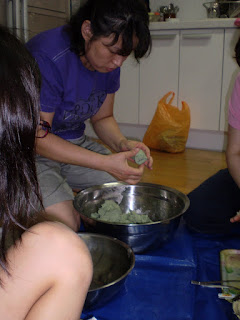 Here's the ssongpyon before it was cooked, and then after:

 Tuesday was Chuseok itself, and we woke up veeerrry early to drive to Gochang, a nearby town, to see my host father's parents. I don't have any pictures from here on out, since I felt so grateful already just for being allowed to come along at all. Anyway, my host father's grandparents' house was filled with relatives (and a ton of adorable little kids). Once everybody was there, lots of food was set out on a table in the middle of the room, and the men stood in front of the table and bowed to it. This is the food that would later be placed on the graves of the family's ancestors. It's interesting to note that Chuseok is a holiday dating back to Confucianism, and part of the Confucian philosophy is a distinct separation of men and women. As a result, only men are allowed to participate in the rituals.
 All in all, I really enjoyed spending time and bonding with my host family, not to mention getting three days off of work! But, I have to admit, it made me miss home just a little bit. It was wonderful meeting my host family's relatives and seeing how they spend their holidays, but I couldn't help thinking about Christmas at my grandparents' house, and that sort of thing. It really sneaks up on you - "This is just like how my family acts on the holidays! Oh...my family..." And driving out to the middle of the rice paddies, with only farm houses and mountains in the distance, naturally made me think of Iowa (except for the mountains). Much as I love cities, farmland has a great way of relaxing you.
Chuseok is a day for honoring one's ancestors. The day before, on Monday, everybody makes rice cakes called ssongpyon (I really don't know if that's romanized correctly at all, so I apologize). You take the dough and fill it with sesame seeds, red beans, or other mixtures I didn't recognize, then fold the dough up like dumplings. Here are some of the bowls of ingredients:
This picture's a shot of my host mother kneading the dough:Here's the ssongpyon before it was cooked, and then after: Tuesday was Chuseok itself, and we woke up veeerrry early to drive to Gochang, a nearby town, to see my host father's parents. I don't have any pictures from here on out, since I felt so grateful already just for being allowed to come along at all. Anyway, my host father's grandparents' house was filled with relatives (and a ton of adorable little kids). Once everybody was there, lots of food was set out on a table in the middle of the room, and the men stood in front of the table and bowed to it. This is the food that would later be placed on the graves of the family's ancestors. It's interesting to note that Chuseok is a holiday dating back to Confucianism, and part of the Confucian philosophy is a distinct separation of men and women. As a result, only men are allowed to participate in the rituals.After the men bowed to the food (I wish a better way to put this, but I only have a limited knowledge of what was going on and don't want to say the wrong thing) we sat down to a big breakfast. We ate fish and the usual plethora of Korean side dishes. The men then spent the morning visiting the graves of their ancestors and leaving offerings of fruit while the women hung out at the house and the kids played.
We ate lunch at my host father's parents' house and returned home in the afternoon. A few hours later, we drove out to another town Boseong (which is famous for its green tea!) to eat dinner with my host mother's parents. Her parents live on a farm with a few cows, where they also grow red peppers and, I think, harvest rice. We ate Jahb Chae (again, forgive my poor attempt at romanization), a buckwheat noodle dish with veggies and meat. Once it was dark, we drove out to the middle of the rice paddies and lit off fireworks, mirroring Monday night, when huge fireworks were let off in Hwasun, like many towns in America do for the 4th of July.
All in all, I really enjoyed spending time and bonding with my host family, not to mention getting three days off of work! But, I have to admit, it made me miss home just a little bit. It was wonderful meeting my host family's relatives and seeing how they spend their holidays, but I couldn't help thinking about Christmas at my grandparents' house, and that sort of thing. It really sneaks up on you - "This is just like how my family acts on the holidays! Oh...my family..." And driving out to the middle of the rice paddies, with only farm houses and mountains in the distance, naturally made me think of Iowa (except for the mountains). Much as I love cities, farmland has a great way of relaxing you.Finally, it's cool to note that even though holidays like Thanksgiving and Chuseok are radically different, they're also very much the same. The family gets together, eats a lot, talks about everything. That's one thing I've notice a lot in Korea - everything is different, but so much is the same.
Friday, September 21, 2007
Pictures! From Hwasun
As promised, here are some pictures of my school, of Gwangju, and of my host family. I wish I had a good picture to show you of the town of Hwasun itself, but honestly, it's such a small town (and I never have a good enough view from the bus). Just imagine a cluster of high-rise apartments and brightly-lit streets, seemingly surrounded by rice paddies and, just a little farther out, green-blue mountains.
Now on to the actual pictures!
First up, here's my school. The long white building on the right is the main school building, while the red brick building in the back is the cafeteria and boys' dormitory. Behind that building is the girls' dormitory.
 This is the view from the front entrance to my school. You can see the dirt field where the kids play soccer during phys ed classes and the gym in the background, to the right.

This is a bad picture of some of my students outside. They do mandatory stretching with the students everyday between 4th and 5th period. I tried to take a surreptitious picture from the teacher's room, and it's not a very good one, but you can at least catch a glimpse of some of my students.

 Next, these are my host sisters. Mi-na is the one who has her hands blocking her face. (The peace sign, by the way, is done by almost all Koreans when they take pictures. It's extremely cute. I've already started doing it myself.) Anyway, Mi-na is in her first year of middle school, which corresponds to seventh grade in the United States. She's very sweet, and although her English is still limited, I think she's quite good given her age. Furthermore, she tries very hard and is usually not shy about just trying to talk, which is the most important part of learning a language anyway!

Now on to the actual pictures!
First up, here's my school. The long white building on the right is the main school building, while the red brick building in the back is the cafeteria and boys' dormitory. Behind that building is the girls' dormitory.
This is the view from the front entrance to my school. You can see the dirt field where the kids play soccer during phys ed classes and the gym in the background, to the right.This is a bad picture of some of my students outside. They do mandatory stretching with the students everyday between 4th and 5th period. I tried to take a surreptitious picture from the teacher's room, and it's not a very good one, but you can at least catch a glimpse of some of my students.
Host family time! I haven't wrangled my host parents into taking a picture yet. But I do have some excellent pictures of my host siblings!
Here's my host brother, Yeo-nu (pronounced Yaw-nu). You might be able to guess from this picture that he's around four years old that he's noisy, always moving around and pretending that he's some sort of superhero, beating up and climbing all over the rest of us. Or maybe you couldn't guess that. But if you did, you'd be right. I've successfully taught him "hi!", "bye!", and "oh no!". I also taught him "water," briefly, but I think he forgot it. Besides, I think he generalized water to include the fish bowl that was surrounding the water at the time. Language learning in little kids is cool to watch.
 Next, these are my host sisters. Mi-na is the one who has her hands blocking her face. (The peace sign, by the way, is done by almost all Koreans when they take pictures. It's extremely cute. I've already started doing it myself.) Anyway, Mi-na is in her first year of middle school, which corresponds to seventh grade in the United States. She's very sweet, and although her English is still limited, I think she's quite good given her age. Furthermore, she tries very hard and is usually not shy about just trying to talk, which is the most important part of learning a language anyway!
Beside Mi-na is Ji-eun. She's in, I believe, fourth grade. She's this incredibly sweet, energetic little girl, and she ALWAYS has a smile on her face. She's only been learning English for a few months, so between the both of us, we usually communicate in smiles and giggling. But you'd be surprised how far that can take you!

This is a picture from downtown Gwangju, where I spend a lot of time. It's nice to go into the city and relax. Anyway, the fountain in the picture is a famous fountain in memorial of the May 15, 1980 uprising against the government. This is the only picture I managed to get without a car in front of the fountain. I just love that you can see the mountain in the background. My favorite thing about Korea is that no matter where you are, you feel like you're nestled in a little valley, a little more alone but a lot closer to nature. I'm feeling a little mountain-obsessed these days. Can you tell? I think I need to start seriously hiking again.

Finally, my room. The first is a picture of my chair and desk. It's very messy in this picture, and rest assured that I've since cleaned my room quite a bit. (I took this picture while I had a nasty cold and wasn't motivated to do much other than sleep). But if it wasn't a little messy, it wouldn't really be my room, right?

Here's my bed. My comfy, comfy bed. And my bookcase. Which now contains a copy of Le Petit Prince in both English and Korean! I'm hoping to improve my Korean skills a little with it. I also have a copy of Hans Christian Andersen's fairy tales with Korean definitions on the bottom, so that will help too.

This coming week is Chuseok, a major Korean holiday, so I'm off of work until next Thursday. It looks like I'll be spending lots of time with my host family and participating in traditional Korean Chuseok rituals, and I'm very much looking forward to that!
Sunday, September 16, 2007
Pictures! From the end of Orientation
Hey all!
Sorry it's been so long since my last blog update. I really wanted to show you pictures of where I am and what I'm doing, but I was having camera problems. Basically, my new camera came without a cable to plug in the battery charger, and I couldn't even get my old pictures off my camera until I finally tracked a replacement cable down. But I'm back! And before I show you pictures of Hwasun, here are some that I had left from Orientation in Chuncheon.
Most of the time in Chuncheon, we ate in the cafeteria at Kangwon University. But here's a picture of a traditional Korean meal. It involves many, many side dishes, most of which are spicy, and everyone sharing from the same dishes.
 This picture is simple. I ate, therefore I'm happy.
 One weekend of Orientation we went to Songnisan, a mountain resort in central Korea. The exective director of Fulbright Korea billed it as a chance to relax and forget about the Korean language for a while. Here's a picture of the river from Songnisan, with the mountains in the background. It was gorgeous there. The fresh air did its job and purged my mind of all the Korean I knew.

Sorry it's been so long since my last blog update. I really wanted to show you pictures of where I am and what I'm doing, but I was having camera problems. Basically, my new camera came without a cable to plug in the battery charger, and I couldn't even get my old pictures off my camera until I finally tracked a replacement cable down. But I'm back! And before I show you pictures of Hwasun, here are some that I had left from Orientation in Chuncheon.
Most of the time in Chuncheon, we ate in the cafeteria at Kangwon University. But here's a picture of a traditional Korean meal. It involves many, many side dishes, most of which are spicy, and everyone sharing from the same dishes.
 This picture is simple. I ate, therefore I'm happy.
 One weekend of Orientation we went to Songnisan, a mountain resort in central Korea. The exective director of Fulbright Korea billed it as a chance to relax and forget about the Korean language for a while. Here's a picture of the river from Songnisan, with the mountains in the background. It was gorgeous there. The fresh air did its job and purged my mind of all the Korean I knew.
In Songnisan there's a Buddhist temple called Beopjusa. Beopjusa is famous for having one of the tallest statues of Buddha in Asia. It's amazing.


 We drank green tea at the ceremony. It was goooood!


The entire temple are was very beautiful. It had this peaceful energy about it that's difficult to explain. But I think anyone who's been to a historical religious place, whether it be a church, a temple, or just a spiritual area, will have an idea of what I'm talking about.
I haven't had the heart to look up what the Korean on this sign actually says. But in my mind, it says "Beware of squirrels," and I giggle and think of Grinnell.

Actually, at one place I visited in Chuncheon, I saw Koreans taking pictures of a squirrel in a tree. Maybe squirrels are really rare in Korea? I haven't figured that one out yet.
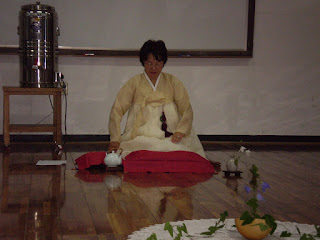
While in Chuncheon, I had the chance to learn about Dado, the traditional Korea tea ceremony. I'm a dedicated tea drinker, so naturally I signed up immediately for this activity. It's a very beautiful, precise process, but I think its precision has an effect almost like meditation. I felt quite serene at calm by the end of the cereomny. Here's a picture of our teacher, followed by one of me trying not to spill hot water all over the place:

 We drank green tea at the ceremony. It was goooood!
Those are all the pictures I wanted to show you for now. WIthin the next week: Hwasun! Students! Host family! My messy, messy room!
But before next time, I should tell you one more thing: I got a straight-perm for my hair. See, the weather in Korea so far has ranged from hot and humid (not good to my naturally-curly hair) or constant rain (even worse for my naturally-curly hair). So I made the difficult decision to get my hair straightened. Here's the "after":

It will stay this way for about 5 months. It's very straight and very thin, and honestly, I prefer the volume my hair had before, which you can see in some of the previous pictures I posted. But it's definitely been easier to manage! I step out of the shower, give my hair a quick towel-dry, and one hour later it's dry, neat, and frizz-free!
Thanks for reading!
Monday, August 27, 2007
So you're moving to Hwasun!
...or in my case, so you moved to Hwasun, a small town of 75.000 on the southern end of Korea, a week ago. Soooo, what have I been up to? Luckily, the response can be easily parsed based on my two primary environments in Hwasun: my school and my homestay
School
My school is outside Hwasun, so I ride the bus from school every day and to school twice a week (the other three days I have first-period class, so I drive with my co-teacher. My school is in a very rural area, which I think makes it quite pretty. Lots of rice fields (and of course mountains) surround the school and town, and there are no high-rise apartments to be seen - which in Korea is a sign of a truly rural area.
All the teachers at my school have been very kind to me so far. The English teachers all speak English well, and I've also become used to speaking very slowly, pronouncing every consonant, and using simpler words/phrases than I would use with other native speakers. So communication has not been too difficult. I have my own desk and computer in the 교무실, or teacher's office, and the classrooms all have access to PowerPoint (which I think will be a staple of my classes).
And then there are my students. So far, for the most part, I love my students. Most of them seem, by first appearances, to be sweet, energetic kids. My school is co-ed, so I teach both boys and girls, but the classes are separated by gender. I've noticed that it's a lot easier for me to connect with my female students, since I'm a girl myself. I definitely have a different energy and even teaching style around my male students - I'm a little less "cute," I make fewer references to pop culture and attractive celebrities, and I'm definitely more "no-nonsense." The students here are also fairly good at English, considering their age. Since my first lesson, I've learned that they're perhaps a little less advanced than I thought, but I'm still hoping to do mostly fun, creative stuff with them. To be honest, I don't want to teach grammar - they learn a ton of grammar in their regular English classes, and they do less speaking than anything else. So I want to have a more relaxed class, ideally, with lots of conversation. Will it work? Um, don't know. Check back with me in a few months!
Homestay
I live in a homestay in Hwasun (in an apartment building) with a family of 5: mother and father, one middle-school girl, one elementary-school girl, and a 4-year-old boy. The kids are extremely, extremely cute. The two youngest fight a lot, but they're energetic and are always smiling around me. I probably talk to my homestay mom and middle-school sister (Mina) the most. I talk to Mina in English, since I think it's a great opportunity help her improve her English, and I'd like to give back to the family somehow. She's pretty good at speaking, given her age and level, but we both have to take roundabout methods to describe things sometimes. I also speak to the other two kids in English, when I can, although they really only know a handful of words each. But, and I could be wrong about this, I believe they're already starting to improve their vocabulary from talking to me. I talk with my host parents in Korean when I can, and they try to use English words around me when they know them. My homestay family is, I must say, extremely kind. I have my own room with a bed and table, but I try to spend time in the living room with the rest of them when I'm not too tired after work. We watch TV together a lot, usually soccer or Korean dramas. I think I prefer soccer - it's a lot easier to follow what's going on! The only negative part of my homestay is that I can't do a lot for myself. I try to offer to wash the dishes, or do the laundry, but my homestay mother won't let me and it's difficult to insist on doing something, or explain how much you want to do something, when you speak different languages. Honestly, I kind of miss the independence and control that comes with doing one's own chores. I guess I don't like feeling that things are out of my control.
But as I said, my homestay family so far has been wonderful. They're very understanding of my limited Korean, and although communication is difficult, we usually get our points across. As for Hwasun itself, I don't have much of a sense of the town yet - it's got a few main stretches, several grocery, clothing, and stationary stores, and of course the high-rise apartment buildings. This weekend I'll hopefully spend some time just walking around and getting lost (something I've done quite a lot lately - but that's a blog for another time) and getting to know the Hwasun a little bit better.
So those are my experiences from the first week and a half in a nutshell. I'll have more specific blogs of what I've been up to once I settle in, with photos (I promise...)! In the meantime, leave a comment, shoot me an email, say hello - it's great to hear from familiar people when you're thrown into a new place like this! Take care, and hey, if you find yourself in southern Korea and want to get away from the cities for a while - well, I do have a small couch in my bedroom. ;)
School
My school is outside Hwasun, so I ride the bus from school every day and to school twice a week (the other three days I have first-period class, so I drive with my co-teacher. My school is in a very rural area, which I think makes it quite pretty. Lots of rice fields (and of course mountains) surround the school and town, and there are no high-rise apartments to be seen - which in Korea is a sign of a truly rural area.
All the teachers at my school have been very kind to me so far. The English teachers all speak English well, and I've also become used to speaking very slowly, pronouncing every consonant, and using simpler words/phrases than I would use with other native speakers. So communication has not been too difficult. I have my own desk and computer in the 교무실, or teacher's office, and the classrooms all have access to PowerPoint (which I think will be a staple of my classes).
And then there are my students. So far, for the most part, I love my students. Most of them seem, by first appearances, to be sweet, energetic kids. My school is co-ed, so I teach both boys and girls, but the classes are separated by gender. I've noticed that it's a lot easier for me to connect with my female students, since I'm a girl myself. I definitely have a different energy and even teaching style around my male students - I'm a little less "cute," I make fewer references to pop culture and attractive celebrities, and I'm definitely more "no-nonsense." The students here are also fairly good at English, considering their age. Since my first lesson, I've learned that they're perhaps a little less advanced than I thought, but I'm still hoping to do mostly fun, creative stuff with them. To be honest, I don't want to teach grammar - they learn a ton of grammar in their regular English classes, and they do less speaking than anything else. So I want to have a more relaxed class, ideally, with lots of conversation. Will it work? Um, don't know. Check back with me in a few months!
Homestay
I live in a homestay in Hwasun (in an apartment building) with a family of 5: mother and father, one middle-school girl, one elementary-school girl, and a 4-year-old boy. The kids are extremely, extremely cute. The two youngest fight a lot, but they're energetic and are always smiling around me. I probably talk to my homestay mom and middle-school sister (Mina) the most. I talk to Mina in English, since I think it's a great opportunity help her improve her English, and I'd like to give back to the family somehow. She's pretty good at speaking, given her age and level, but we both have to take roundabout methods to describe things sometimes. I also speak to the other two kids in English, when I can, although they really only know a handful of words each. But, and I could be wrong about this, I believe they're already starting to improve their vocabulary from talking to me. I talk with my host parents in Korean when I can, and they try to use English words around me when they know them. My homestay family is, I must say, extremely kind. I have my own room with a bed and table, but I try to spend time in the living room with the rest of them when I'm not too tired after work. We watch TV together a lot, usually soccer or Korean dramas. I think I prefer soccer - it's a lot easier to follow what's going on! The only negative part of my homestay is that I can't do a lot for myself. I try to offer to wash the dishes, or do the laundry, but my homestay mother won't let me and it's difficult to insist on doing something, or explain how much you want to do something, when you speak different languages. Honestly, I kind of miss the independence and control that comes with doing one's own chores. I guess I don't like feeling that things are out of my control.
But as I said, my homestay family so far has been wonderful. They're very understanding of my limited Korean, and although communication is difficult, we usually get our points across. As for Hwasun itself, I don't have much of a sense of the town yet - it's got a few main stretches, several grocery, clothing, and stationary stores, and of course the high-rise apartment buildings. This weekend I'll hopefully spend some time just walking around and getting lost (something I've done quite a lot lately - but that's a blog for another time) and getting to know the Hwasun a little bit better.
So those are my experiences from the first week and a half in a nutshell. I'll have more specific blogs of what I've been up to once I settle in, with photos (I promise...)! In the meantime, leave a comment, shoot me an email, say hello - it's great to hear from familiar people when you're thrown into a new place like this! Take care, and hey, if you find yourself in southern Korea and want to get away from the cities for a while - well, I do have a small couch in my bedroom. ;)
Monday, August 13, 2007
Visiting the Scariest Place on Earth
In the summer after my junior year of high school, I was lucky enough to visit France with my French class. We spent an afternoon in Normandy, the location the Allied troops stormed on D-Day during World War II. I was astounded by how beautiful it was there - stark cliffs, crashing waves, greenery and foliage. Despite its violent history, or perhaps because of it, Normandy had become a peaceful, picturesque place.
I did not expect the DMZ (Demilitarized Zone, the 4-km area separating North and South Korea) to be the same. I had heard the DMZ was very pretty, since hardly anybody enters that area anymore. However, when Bill Clinton visited the DMZ in 1993 he called it "the scariest place on earth." I suppose I imagined it to be more of the latter, and I had a chance to put my perceptions to the test today when we visited the DMZ. As it turns out, I think that it is both one of the more beautiful places I've seen and also one of the most chilling.
We didn't go to Panmunjom, which is just north of Seoul with large military bases on both sides of the dividing line, and as Panmunjom is where most people go when they visit the DMZ. But because of the six-party talks currently taking place, we weren't able to go there, and instead visited a base not too far north of Chuncheon, in Hacheon. Unfortunately, you're not allowed to take pictures there, so I'll try to describe it. Imagine tall, ridged, green mountains stretching as far as the eye can see to the North. You can see small red fences that look like footpaths running from east to west, from horizon to horizon. Several small farms dot the landscape in front of you.
That's North Korea.
Like Normandy, it was naturally beautiful, well-preserved, and disarmingly peaceful. I say "disarmingly" because, unlike Normandy, the DMZ is still the front of a war that, despite a ceasefire, never officially ended. The soldiers who gave us a tour of their outpost showed us photos they had taken the North Korean soldiers on the other side - photos of North Koreans hunting, playing basketball, and smoking cigarettes. Meanwhile, the South Korean soldiers assured us, their Northern counterparts did the same. They were probably watching us Americans stand around, right at the border, gazing back at them. Our soldier tour guide ended by telling us that they were ready at all times to defend the country when North Korea attacks.
I don't think another outbreak of the Korean War is at all likely. Relations between the two Koreas are actually rather friendly right now, with South Korea sending regular shipments of food and supplies to help out the impoverished people of North Korea. But that tension, the fact that both sides were constantly watching and are ready to attack the others at any time, is, I think, what makes the DMZ so scary at the same time that it's almost breathtakingly gorgeous.
I did not expect the DMZ (Demilitarized Zone, the 4-km area separating North and South Korea) to be the same. I had heard the DMZ was very pretty, since hardly anybody enters that area anymore. However, when Bill Clinton visited the DMZ in 1993 he called it "the scariest place on earth." I suppose I imagined it to be more of the latter, and I had a chance to put my perceptions to the test today when we visited the DMZ. As it turns out, I think that it is both one of the more beautiful places I've seen and also one of the most chilling.
We didn't go to Panmunjom, which is just north of Seoul with large military bases on both sides of the dividing line, and as Panmunjom is where most people go when they visit the DMZ. But because of the six-party talks currently taking place, we weren't able to go there, and instead visited a base not too far north of Chuncheon, in Hacheon. Unfortunately, you're not allowed to take pictures there, so I'll try to describe it. Imagine tall, ridged, green mountains stretching as far as the eye can see to the North. You can see small red fences that look like footpaths running from east to west, from horizon to horizon. Several small farms dot the landscape in front of you.
That's North Korea.
Like Normandy, it was naturally beautiful, well-preserved, and disarmingly peaceful. I say "disarmingly" because, unlike Normandy, the DMZ is still the front of a war that, despite a ceasefire, never officially ended. The soldiers who gave us a tour of their outpost showed us photos they had taken the North Korean soldiers on the other side - photos of North Koreans hunting, playing basketball, and smoking cigarettes. Meanwhile, the South Korean soldiers assured us, their Northern counterparts did the same. They were probably watching us Americans stand around, right at the border, gazing back at them. Our soldier tour guide ended by telling us that they were ready at all times to defend the country when North Korea attacks.
I don't think another outbreak of the Korean War is at all likely. Relations between the two Koreas are actually rather friendly right now, with South Korea sending regular shipments of food and supplies to help out the impoverished people of North Korea. But that tension, the fact that both sides were constantly watching and are ready to attack the others at any time, is, I think, what makes the DMZ so scary at the same time that it's almost breathtakingly gorgeous.
Subscribe to:
Posts (Atom)